- Subletting means renting out your rented home, fully or partly.
- Landlords find out through society records, bills, security logs, or Airbnb-style listings.
- The first response is almost always a legal notice.
A tenant in Bangalore rents a 2BHK apartment for himself. Six months later, he moves to another city for work and quietly puts a stranger in the flat, collecting rent on the side. He assumes that it is harmless. But in reality, it is not.
Under the Karnataka Rent Act, unauthorised subletting attracts a fine of Rs 5,000 or double the rent, or even a month in jail. In 2025, the state cleared an amendment to raise this penalty to Rs 50,000, a 900% jump.
This is not a one-off. Across India, unauthorised subletting is one of the fastest ways to lose your tenancy, and in some cases, your money too.
This article breaks down exactly what counts as subletting, how landlords catch it, and what happens once you are caught.
- Subletting means renting out your rented home, fully or partly.
- Landlords find out through society records, bills, security logs, or Airbnb-style listings.
- The first response is almost always a legal notice.
- A tenant is responsible for any damage or unpaid dues caused by the sub-tenant.
- Listing a rented flat on platforms counts as subletting too.
What Counts as "Subletting" And What Doesn't
Subletting means that the tenant, who has rented the property from a landlord, rents out the whole or a part of the property to a sub-tenant, in exchange for money, without the landlord's written consent. They create a new arrangement inside their own tenancy.
The Model Tenancy Act, 2021 states that a tenant cannot sublet the premises without the prior consent of the landlord. Here is where confusion usually creeps in. Not every extra person in the house is a sub-tenant. The following table explains it well:
| Situation | Is it subletting? |
|---|---|
| A friend or relative stays for a few weeks | No |
| A colleague pays a fixed monthly amount to share a flat | Yes, if it is long-term and undisclosed |
| A paying guest under a proper PG arrangement with the landlord's knowledge | No, if the landlord is informed and terms are separate |
| The tenant moves out and rents the place to a stranger | Yes |
| A room or the whole place is listed on Airbnb | Yes |
If money is changing hands without the landlord's knowledge, then it is unauthorised subletting.
How Landlords Catch Unauthorised Subletting
Most tenants assume that they are safe because the landlord rarely visits. But the landlord does not need to show up. They can keep track through:
- Society or RWA complaints: Most Resident Welfare Associations maintain visitor and tenant registers. A new face living in the flat is reported to the landlord.
- Utility bill mismatches: If electricity or water usage increases, or if a new name appears on bills, it signals a change in occupancy.
- Neighbour tip-offs: A different family, routines, or vehicles parked in the same spot every day are noticeable.
- Security records: A tenant listed on paper but rarely seen, alongside someone else who comes and goes daily, is easily flagged by security staff.
- OTA listings: A search on OTA platforms can expose a tenant who is renting out the property without permission.
Once any of these surfaces, the word reaches the landlord.
What Happens the Moment You're Caught: The Landlord's First Move
A Landlord's first step is a legal notice, which does two things:
- It asks the tenant to explain the unauthorised occupant.
- It demands the sub-tenant to vacate within a duration.
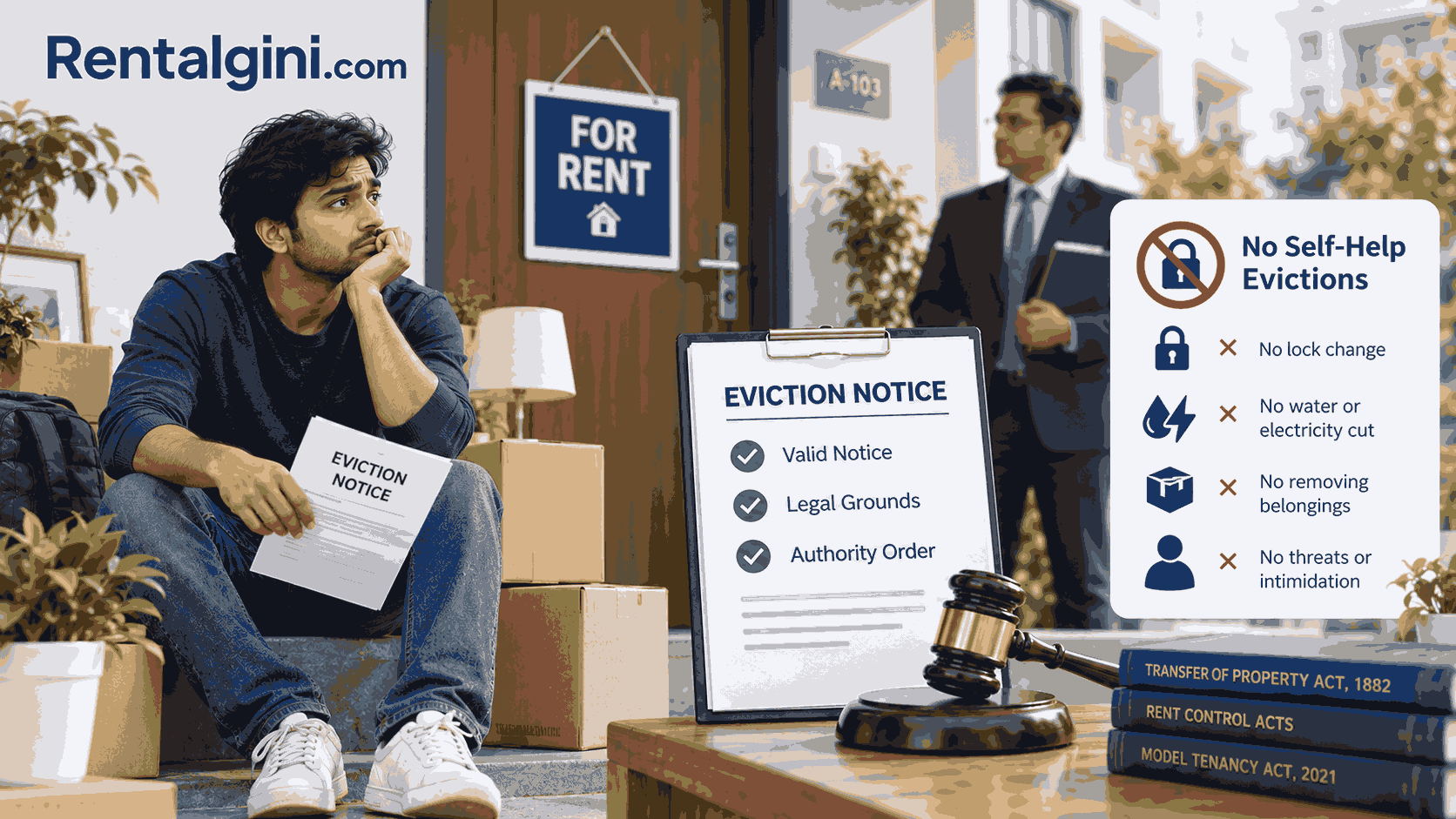
If not complied with, the landlord sends a termination notice, ending the tenancy. Under the Transfer of Property Act, 1882, unauthorised subletting is a ground for terminating a tenancy. If the tenant does not vacate even after the termination notice, the landlord can approach a rent court or civil court.
Depending on the state, eviction proceedings can take a few months to a couple of years. Courts side with the landlord once unauthorised subletting is established, since it is a straightforward breach of the tenancy terms.
Financial Liability: Are You Responsible for Your Sub-Tenant's Actions?
This part surprises most tenants. The landlord's legal relationship is with the tenant, not with the sub-tenant. A tenant is responsible for their sub-tenant's actions like:
- Property damage: Broken fittings, wall damage, or unauthorised structural changes.
- Unpaid dues: Any pending society maintenance or utility bills.
- Misuse of the property: Running a business from the place, or violating society bylaws.
Standard lease clauses apply this principle strongly.
Does Every State Treat Subletting the Same Way?
The core principle is no subletting without the landlord's consent. But the fine print differs by state, because housing and tenancy fall under the State List in the Indian Constitution, implying that each state legislates its own rent control framework. A few examples show the spread:
- Karnataka treats unauthorised subletting as an offence with a penalty and, in the current law, a possible jail term of up to one month. The state is steeply raising the fine.
- Delhi treats subletting without consent as a valid ground for eviction. However, the Act itself applies only to properties below a certain rent threshold, with high-rent tenancies falling outside its protection and governed by the Transfer of Property Act.
- States that have adopted the Model Tenancy Act build in agreements the requirement for subletting as a baseline. Penalties and dispute resolution are routed through Rent Authorities and Rent Courts.
Before making any assumptions, check your state's rent control law or your rent agreement's clause on subletting.
The Short-Term Rental Trap: Is Listing Your Rented Flat Illegal?
This is where tenants get in trouble. Listing a rented flat or even a room on Airbnb or another OTA platform is a form of subletting. The fact that the guest stays only a few nights does not change the arrangement's essence. These are some complications beyond the subletting issue:
- RWA bylaws: Most housing societies prohibit short-term or commercial use of residential units. Frequent unfamiliar guests, luggage, and turnover draw immediate attention and result in a complaint to the landlord.
- Municipal short-stay licensing: In cities that regulate short-term rentals, operating one without local permission is non-compliant, along with being a tenancy breach.
- Tax implications: Income earned from short-term listings is taxable. If it is undeclared, it creates exposure not just to the landlord but to tax authorities too.
The safe route is getting written permission from your landlord first, spelled out in an addendum to your rental agreement.
How to Sublet Legally, If You Must
Subletting is not off the table. It just has to be done properly, through the following measures:
- Get written consent from the landlord: Ask for an email or a signed note permitting the sublease.
- Amend the rent agreement: The original lease should be formally updated, or a supplementary agreement drawn up, naming the sub-tenant and the terms under which they occupy the property.
- Inform the RWA: Submit the sub-tenant's details through the society's tenant verification process. This avoids complaints later and keeps your paper trail clean.
- Put sub-tenant terms in writing: Sign a clear agreement with your sub- tenant covering rent, duration, and responsibility for damages. This protects you from disputes, since you remain liable to the landlord.
This way, subletting becomes a legal, documented arrangement.
Conclusion
Subletting without permission might look like a shortcut when you need to cover rent or make use of an empty room. But it rarely stays hidden for long. Once it surfaces, the consequences land on the original tenant, not the sub- tenant.
Legal notices, eviction proceedings, financial liability, and penalties under state rent laws are all real possibilities. The safer path is to talk to your landlord, get their consent in writing, and document the arrangement properly. All it costs is a conversation. The alternative can cost a lot more.

Deepak Kumar
Rental and real estate insightsRentalGini helps tenants, owners, and operators make clearer rental decisions with verified information and practical property guidance.
Want more tenant enquiries?
List your space on RentalGini and help renters compare your property with clear details.